Introduction
Sender reputation is one of the most important factors in email marketing success. Even well-designed email campaigns can fail if email providers do not trust the sender.
Internet Service Providers (ISPs) like:
- Gmail
- Outlook
- Yahoo
- Apple Mail
analyze your email sending behavior to determine whether your emails should reach the inbox or spam folder.
One of the best ways to maintain a strong sender reputation is through proper email verification.
Email verification helps businesses:
- Reduce bounce rates
- Improve inbox placement
- Prevent spam complaints
- Maintain clean email lists
- Increase email engagement
What is Sender Reputation?
Sender reputation is a trust score assigned to your:
- Sending domain
- IP address
- Email infrastructure
Email providers use this score to decide whether your emails are trustworthy.
A strong sender reputation improves:
- Inbox delivery
- Open rates
- Email engagement
A poor reputation can cause:
- Spam filtering
- Email blocking
- Blacklisting
What is Email Verification?
Email verification is the process of checking whether an email address is:
- Valid
- Active
- Deliverable
- Safe to send emails to
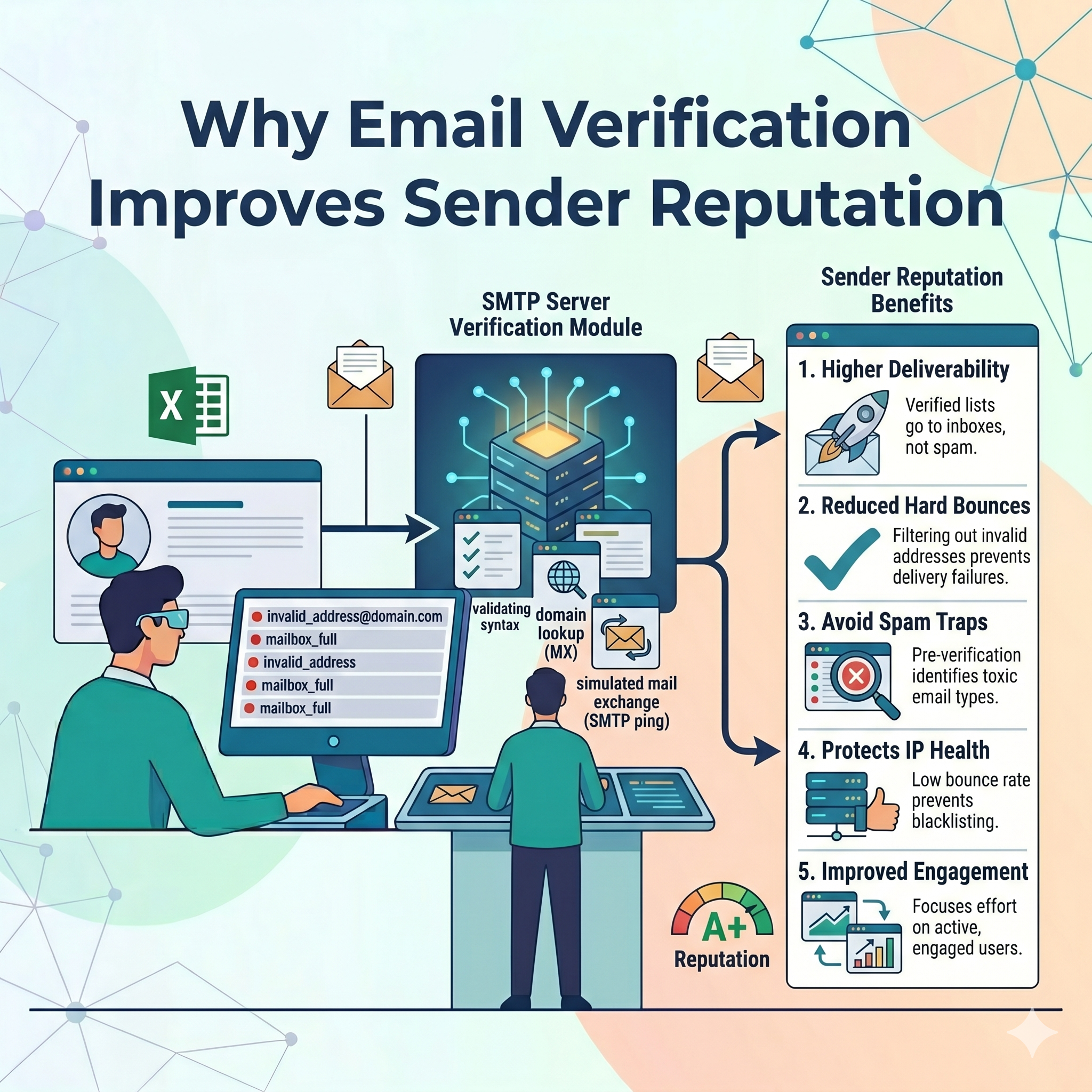
Verification systems usually check:
- Email syntax
- Domain validity
- MX records
- SMTP mailbox existence
- Disposable email detection
- Catch-all domains
This helps maintain a clean and healthy email database.
Reputation & Deliverability
Strong Sender Reputation→Better Inbox Placement\text{Strong Sender Reputation} \rightarrow \text{Better Inbox Placement}Strong Sender Reputation→Better Inbox Placement
Trusted senders are more likely to reach recipients’ inboxes successfully.
How Email Verification Improves Sender Reputation
1. Reduces Hard Bounce Rates
Hard bounces happen when emails are sent to invalid or non-existent addresses.
Examples:
- fake@gmail.com
- typo@gnail.com
High hard bounce rates signal poor list quality to email providers.
Email verification removes invalid addresses before campaigns are sent.
Result
- Lower bounce rates
- Better reputation
- Improved deliverability
Bounce Rate Impact
Lower Bounce Rate→Higher Sender Trust\text{Lower Bounce Rate} \rightarrow \text{Higher Sender Trust}Lower Bounce Rate→Higher Sender Trust
Maintaining bounce rates below 2% helps protect sender reputation.
2. Prevents Spam Trap Hits
Spam traps are email addresses used by anti-spam organizations to identify poor email practices.
Sending emails to spam traps can:
- Damage sender reputation
- Trigger blacklisting
- Reduce inbox placement
Email verification tools help detect risky and suspicious addresses before sending.
3. Improves Inbox Placement
Email providers prioritize trusted senders.
Verified email lists contain:
- Real users
- Active recipients
- Engaged subscribers
This increases the likelihood that emails will reach the inbox instead of spam folders.
4. Increases User Engagement
Verified email addresses belong to real users who are more likely to:
- Open emails
- Click links
- Interact with campaigns
Positive engagement signals improve sender reputation over time.
5. Reduces Spam Complaints
Invalid or outdated email addresses often lead to unwanted emails and spam reports.
Email verification ensures messages are sent only to valid recipients.
Fewer spam complaints help maintain domain trust.
6. Protects Domain Reputation
Your domain reputation directly affects deliverability.
Poor reputation can result in:
- Spam folder placement
- Delivery failures
- Lower open rates
Email verification helps protect domain credibility by maintaining list quality.
7. Prevents Blacklisting
Repeatedly sending emails to:
- Invalid addresses
- Spam traps
- Inactive users
can lead to IP or domain blacklisting.
Verification significantly reduces this risk.