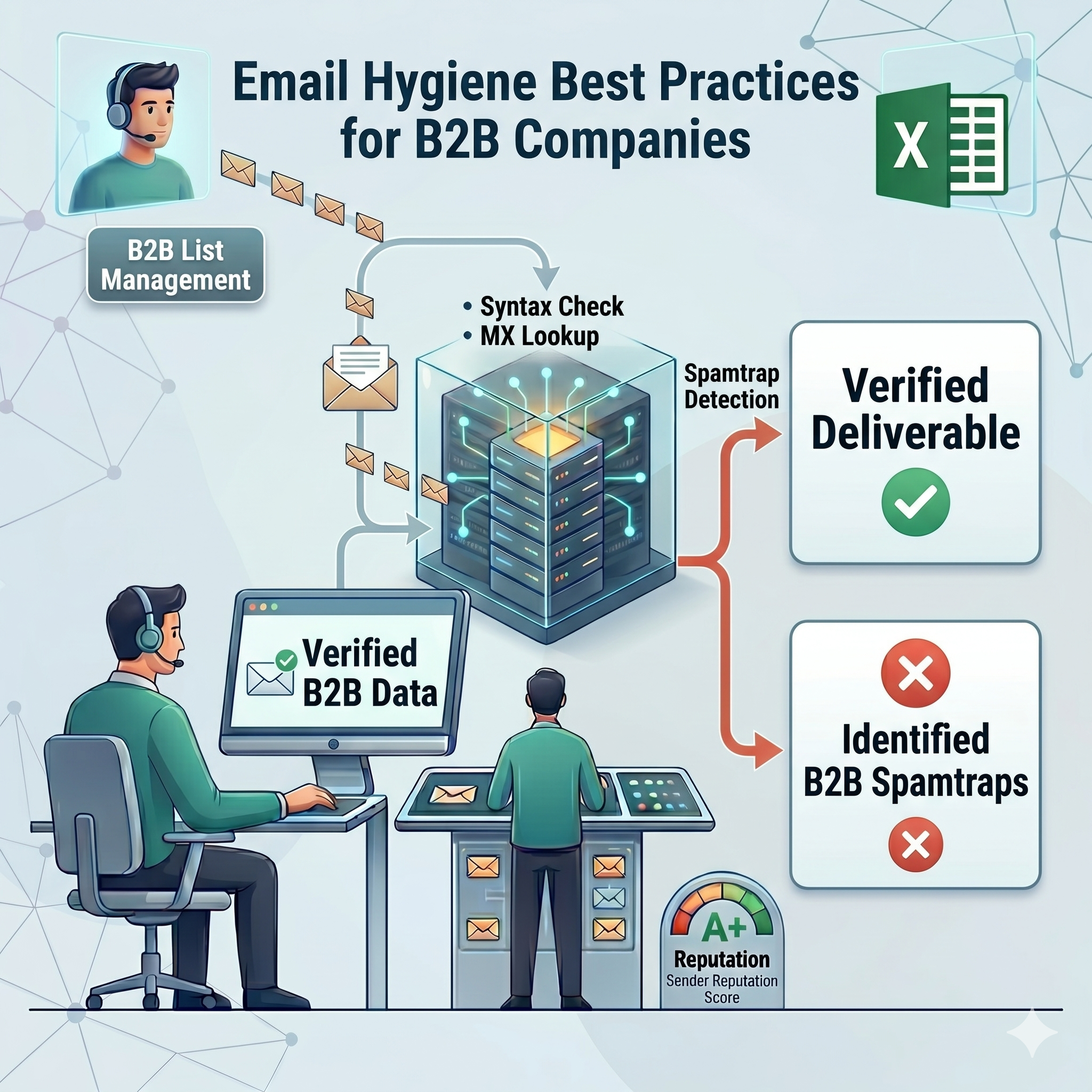
Introduction
Email marketing remains one of the most effective communication channels for B2B companies. However, the success of B2B email campaigns depends heavily on the quality of the email database.
Business email lists change rapidly because:
- Employees switch jobs
- Companies close or rebrand
- Domains expire
- Email accounts become inactive
Without proper email hygiene, B2B companies may face:
- High bounce rates
- Poor deliverability
- Spam complaints
- Blacklisted domains
- Lower marketing ROI
Maintaining strong email hygiene practices is essential for long-term email marketing success.
What is Email Hygiene?
Email hygiene refers to the process of keeping an email list:
- Clean
- Accurate
- Updated
- Verified
This involves removing:
- Invalid email addresses
- Duplicate contacts
- Inactive subscribers
- Spam traps
- Disposable emails
Good email hygiene improves overall email deliverability and sender reputation.
Email Hygiene & Deliverability
Clean Email Database→Better Deliverability & Engagement\text{Clean Email Database} \rightarrow \text{Better Deliverability \& Engagement}Clean Email Database→Better Deliverability & Engagement
Healthy email lists improve inbox placement and campaign performance.
1. Verify Email Addresses Regularly
B2B email databases become outdated quickly.
Employees frequently:
- Change jobs
- Leave organizations
- Switch departments
Regular email verification helps identify:
- Invalid addresses
- Expired domains
- Risky mailboxes
- Catch-all domains
Best Practice
Verify your email database every:
- 30 to 90 days
2. Remove Hard Bounced Emails Immediately
Hard bounces indicate permanent delivery failures.
Examples:
- Non-existent users
- Invalid domains
- Deleted mailboxes
Continuing to send emails to hard bounced addresses can damage sender reputation.
Recommendation
Automatically suppress hard bounced emails from future campaigns.
3. Use Double Opt-In
Double opt-in requires subscribers to confirm their email address before joining your list.
Benefits include:
- Better lead quality
- Lower bounce rates
- Reduced spam complaints
- Improved engagement
This process ensures that collected emails are valid and intentional.
4. Avoid Purchased Email Lists
Purchased B2B email lists often contain:
- Outdated contacts
- Fake addresses
- Spam traps
- Unverified users
Using bought lists can lead to:
- High bounce rates
- Spam filtering
- Poor engagement
Better Alternative
Build your list organically using:
- Website forms
- Webinars
- LinkedIn campaigns
- Lead magnets
- Business events
5. Monitor Email Engagement Metrics
Tracking engagement helps identify unhealthy contacts.
Important metrics include:
- Open rates
- Click-through rates
- Bounce rates
- Spam complaints
- Unsubscribe rates
Inactive users reduce list quality and may hurt deliverability.
Engagement & Reputation
Higher Engagement→Stronger Sender Reputation\text{Higher Engagement} \rightarrow \text{Stronger Sender Reputation}Higher Engagement→Stronger Sender Reputation
Engaged recipients improve trust signals for email providers.
6. Segment Your B2B Email Lists
Not every business contact should receive identical emails.
Segment audiences based on:
- Industry
- Company size
- Job title
- Buyer journey stage
- Geographic location
Targeted campaigns improve engagement and reduce spam complaints.
7. Remove Inactive Subscribers
Inactive subscribers can negatively affect sender reputation over time.
Before removing them:
- Send re-engagement campaigns
- Ask users to confirm interest
- Offer subscription preferences
If there is no response, remove them from active campaigns.
8. Block Disposable Email Addresses
Temporary email services allow users to create short-lived email accounts.
These emails:
- Expire quickly
- Generate poor engagement
- Increase bounce risks
Use email verification systems to detect and block disposable domains.
9. Authenticate Your Email Domain
Email authentication improves trust and deliverability.
Implement:
- SPF
- DKIM
- DMARC
These protocols help email providers verify that your emails are legitimate.